Blog
Insights
How We Conduct Educational Olympiads with Proctoring
Learn how TrustExam.ai conducts online educational olympiads with a practical integrity stack - risk-based proctoring tiers, identity checks, secure browser controls, multisignal detection, evidence timelines, and fair appeals workflows.
Orken Rakhmatulla
Head of Education

Expert opening
I have seen the same tension in almost every olympiad program that tries to scale online. Organizers want wider access and lower logistics cost. At the same time, they cannot afford doubts about fairness. One integrity incident can damage an olympiad brand for years. In this article I explain how we run educational olympiads with proctoring at TrustExam.ai, from planning to governance, so organizers can scale participation and keep results defensible.
Why olympiads are different from regular exams
Olympiads sit between learning and competition. That changes the threat model. Participants are motivated to win. Parents and coaches are involved. Time windows are short. The risk is not only answer sharing. It includes impersonation, covert assistance, second devices, screen mirroring, and organized helper services.
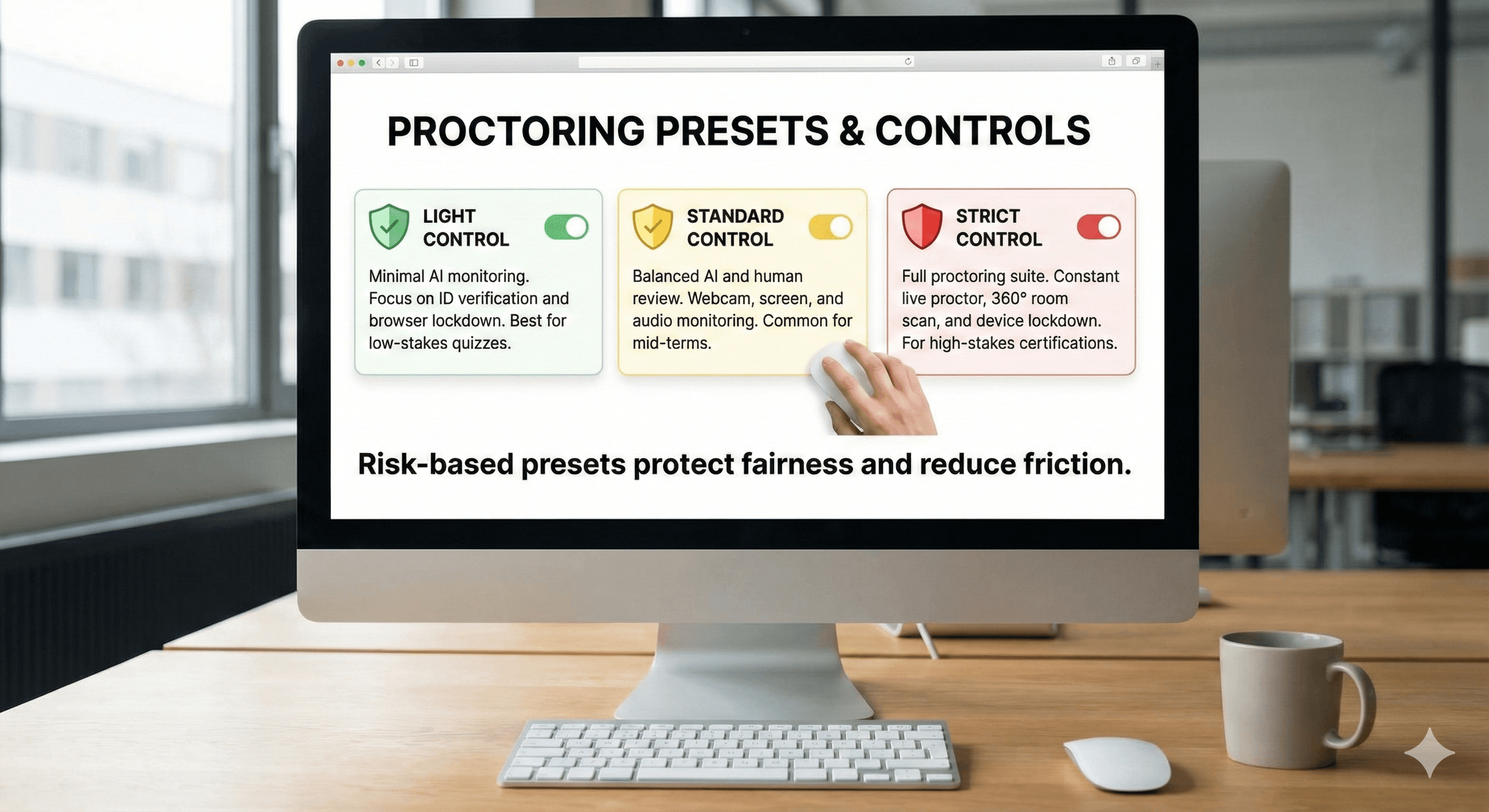
Olympiads also have a fairness constraint. Controls cannot punish honest students or exclude regions with weaker devices. The solution is not maximum strictness. The solution is risk-based design, strong evidence, and clear rules.

Step 1. Pre-olympiad design: integrity goals and constraints
Before any settings, we define what must be protected. For most olympiads, the goals are: prevent impersonation, reduce covert assistance, detect suspicious patterns fast, create evidence for appeals, and keep participant completion rates high.
We then map constraints: age group, device diversity, regions, time zones, language support, and privacy requirements. This is where we decide whether the event is fully remote, hybrid, or includes supervised hubs.
Expert Tip
Do not start with proctoring settings. Start with outcomes. Decide what risk you accept, what you review, and what triggers an appeal.
If you want a structured way to set olympiad integrity levels without over-controlling students, we start with an olympiad risk assessment and a pilot plan. TrustExam.ai online proctoring platform explains the building blocks we use for high-volume events.
Step 2. Registration and identity: the minimum that still works
Olympiad identity assurance depends on stakes. For school olympiads, a light verification flow often works. For national or scholarship-linked olympiads, we recommend stronger identity verification.
Common options we implement: candidate profile and enrollment for repeat participants, document capture for higher-stakes rounds, face match and liveness checks when needed.
The value is not punishment. The value is credibility. Identity verification reduces the easiest substitution path and supports fair ranking when prizes or admissions depend on outcomes.
Step 3. Environment controls: reduce bypass without breaking accessibility
The biggest cheating gains often come from second devices and screen sharing. A secure exam browser reduces that surface. In olympiads, we tune controls for accessibility. The point is to block common bypass methods while keeping legitimate tools available if the rules allow them.
Controls we typically deploy based on olympiad tier include: secure browser and application restrictions, screen capture and screen sharing prevention where legally permitted, device integrity checks including VM detection for high-stakes rounds, and full-screen enforcement for contest focus.
This matters because camera-only proctoring is not enough. Attackers can keep the webcam feed clean while using remote help on the device.
Step 4. Proctoring signals: multisignal detection and risk scoring
During the olympiad window, we collect signals that support evidence-based review. The strongest results come from correlating multiple sources rather than relying on a single indicator.
Signals we use in a typical online olympiad: video signals like face presence and multiple faces, audio anomalies, behavior patterns like response timing, and device events like focus loss or prohibited tools where applicable.
The goal is a risk score that helps reviewers prioritize. It does not auto-assign guilt. It highlights sessions that need human review and produces a timeline of events.
Comparison table
Methods compared by evidence strength, cost, and scalability.
Method | Evidence strength | Cost | Scalability |
No proctoring, honor code only | Low | Low | High |
Live proctors only | Medium | High | Low |
Webcam recording only | Medium | Medium | Medium |
Secure browser only | Medium-High | Medium | High |
Multisignal proctoring + risk scoring + review | High | Medium | High |
For olympiad organizers who need scale without a large live-proctor team, TrustExam.ai uses AI auditing with risk scoring and evidence timelines. This reduces manual load while keeping decisions reviewable. Learn more at AI online proctoring.
Step 5. Operations at scale: windows, load, and incident response
Olympiads create peak load. Thousands of students start at the same minute. That is an operations problem as much as a technology problem.
Our approach includes staged start windows when possible, pre-check flows and device readiness guidance, clear participant support channels, and a defined incident response process for outages, disconnections, and identity exceptions.
This matters because fairness requires equal conditions. If one region struggles with onboarding while another starts smoothly, rankings become controversial. A stable start experience is part of integrity.
Step 6. Review workflow, evidence packets, and appeals
A credible olympiad needs a transparent review and appeals workflow. Otherwise, every flag becomes subjective and organizers face pressure from participants and parents.
We define what gets flagged, who reviews and what evidence they see, what outcomes are possible, and what triggers an appeal and the timeline for response.
Evidence packets are timecoded. Reviewers see the relevant snippets, device events, and a short narrative. This reduces bias and speeds decisions. It also reduces false positives.
Expert Tip
Write your appeals policy before launch. If it is unclear, you will either over-penalize or give in to pressure. Both damage credibility.
Step 7. Governance: privacy, fairness, and retention
Olympiads often involve minors. That raises the bar for privacy and transparency.
We recommend governance controls that are easy to explain: clear notices on what data is collected and why, strict retention schedules and deletion controls, role-based access to recordings and logs, human-in-the-loop decisions for disqualification, and fairness practices like consistent thresholds and reviewer training.
For external framing, many organizers align with university academic integrity policies and widely cited guidance on digital identity and biometric systems such as NIST Digital Identity Guidelines and ISO/IEC 30107-3 for presentation attack detection. These references help explain why layered controls and human review are necessary.
Implementation checklist
A practical delivery plan for moving an olympiad online.
Step | Owner | Deliverable |
Define olympiad integrity goals and tiers | Olympiad director | Integrity level matrix |
Set identity verification and exceptions | Operations + legal | Identity and exception policy |
Configure secure browser and device rules | IT/security | Device control profile |
Set proctoring signals and risk thresholds | Integrity lead | Rules and reviewer thresholds |
Prepare participant onboarding and support | Operations | Setup guide and support playbook |
Run pilot round and calibrate | Program lead | Pilot report and adjustments |
Launch with review and incident response | Integrity team | Monitoring and response plan |
Finalize appeals, retention, and access control | Legal + audit | Governance pack |
If you run olympiads across regions and need a defensible integrity workflow, TrustExam.ai supports compliance-friendly review and reporting for education. Learn more at proctoring for universities and schools.
Conclusion
Online olympiads can scale access, reduce logistics, and include students who could not travel. That benefit disappears if integrity is questioned. The practical path is a layered approach: right-sized identity verification, device and environment controls, multisignal detection with risk scoring, and a transparent review and appeals process backed by evidence. When governance is clear, organizers protect both fairness and reputation.
FAQ
Do olympiads always need strict proctoring?
No. Controls should match stakes. Use tiers. Reserve stricter identity and device checks for finalist rounds or prize-linked events.
How do you keep student experience reasonable?
Use risk-based triggers, clear setup guidance, and limit interruptions. Review risk in the background rather than constantly prompting.
What is the most common integrity failure in online olympiads?
Relying on a webcam only and skipping device controls. Many assistance methods happen on the device, not in front of the camera.
How do you handle disputes and parent complaints?
Use a documented appeals process with timecoded evidence packets. Human reviewers make final decisions. Retention and access rules are stated in advance.
What is a safe way to start if the olympiad is moving online for the first time?
Run a pilot round, calibrate thresholds, and test operations under peak load. Then scale in phases, with clear governance from day one.
Orken Rakhmatulla
Head of Education
Share