Blog
Insights
The Integrity Gap in 2026: Why Video Monitoring Is No Longer Enough
In 2026, video-only proctoring cannot stop sophisticated cheating like VMs, AI assistance, and device spoofing. Learn the multi-signal integrity model universities and certification bodies need.
Orken Rakhmatulla
Head of Education
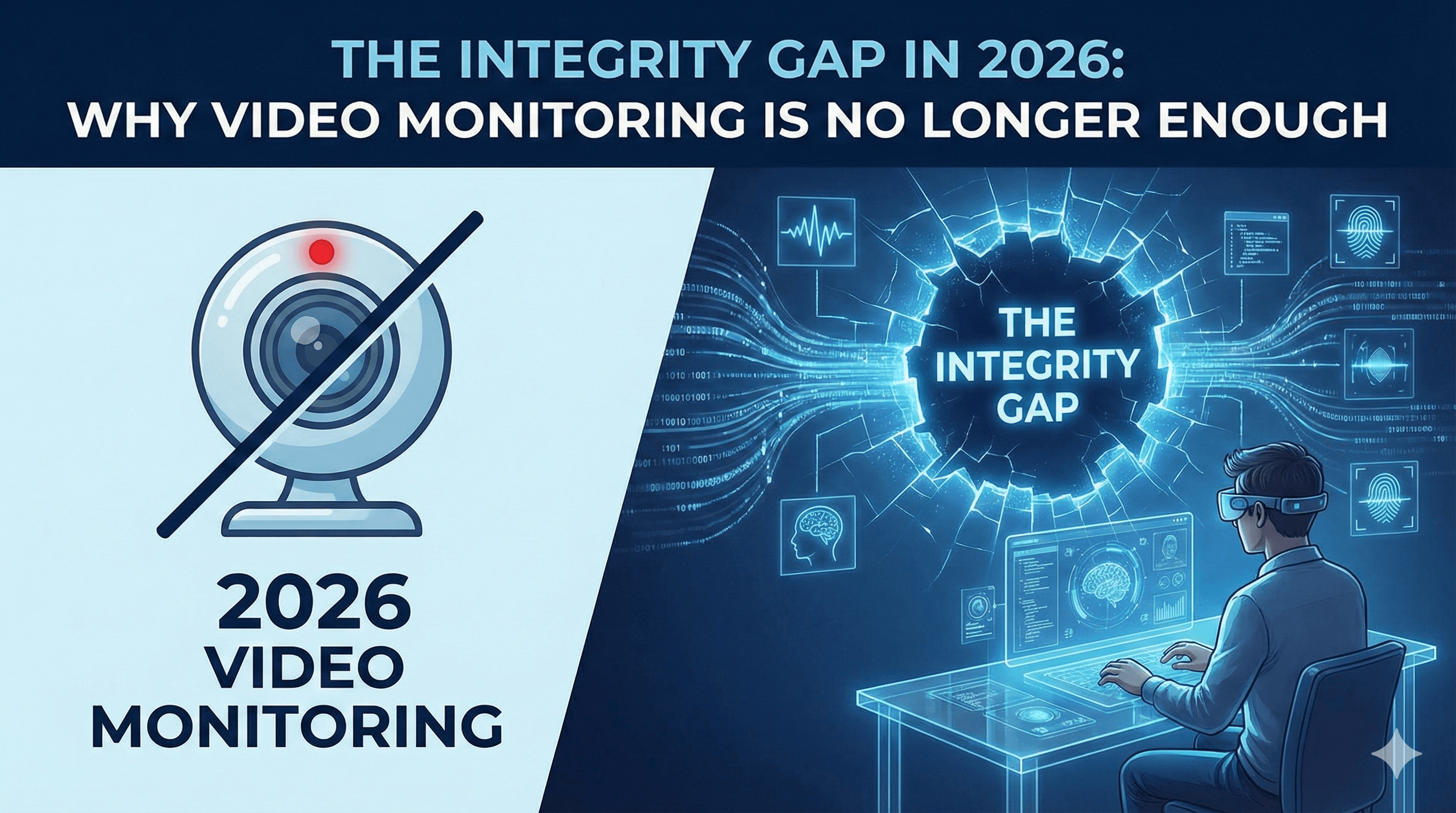
For years, remote assessment relied on a simple idea: if a camera is on, integrity is protected. That approach is now creating an integrity gap. Not because proctors stopped paying attention, but because cheating evolved faster than video monitoring.
University leaders and certification bodies face a new reality. High-stakes outcomes attract sophisticated methods that do not look suspicious on camera. Candidates can appear calm, compliant, and focused, while the real attack happens outside the webcam frame. When results carry admissions, licensing, or professional status, video-only controls no longer provide a defensible standard.
This article explains what changed, how modern cheating works, and what a comprehensive integrity model looks like in 2026.
1) What changed: cheating moved from “behavior” to “infrastructure”
Traditional proctoring looked for visible behavior:
looking away
whispering
another person entering the room
using a phone
Those signals still matter. But the most damaging methods now hide inside the candidate’s technical setup and workflow. That shift breaks video-only proctoring because video mainly captures the candidate, not the system.
In 2026, the most common integrity failures come from three categories:
Environment virtualization
Candidates run the exam inside a virtual machine or through remote desktop workflows. The proctor sees a normal face. The attack is happening at the OS and device layer.Second device orchestration
A second laptop, tablet, or phone runs parallel support. It is out of frame, or mirrored through hidden channels. Video catches less than teams assume.AI-mediated assistance
Candidates can get real-time help with answers, reasoning, and code. The candidate’s expression remains neutral. The output quality changes, but video does not.
This is why integrity now requires more than observation. It requires verification of the environment, the session, and the evidence trail.
2) The new integrity threat model: what video misses
Virtual machines and remote workspaces
VM-based test taking can bypass browser restrictions and hide unauthorized tools. A candidate can run a “clean” surface while using a separate layer underneath for search, chat, or remote assistance.
Why this matters for provosts and certification owners: If a credential is questioned, you need to show controls that prevented bypass, not only that a camera was on.
Screen mirroring and hidden I/O paths
Mirror setups can route content and inputs through HDMI splitters, capture cards, or remote desktop tooling. A proctor sees a single screen. The candidate uses a secondary pathway.
Why this matters: You cannot defend integrity if the platform cannot tell whether the exam screen is the actual environment.
AI help that does not look suspicious
AI-assisted cheating often looks like “good performance.” It rarely looks like the candidate is cheating. The signals are typically:
unusually consistent response quality
fast reasoning jumps without intermediate work
answer patterns that match known AI output tendencies
code solutions that are stylistically uniform across candidates
Why this matters: If your integrity controls only watch faces, you are defending results with weak evidence.
3) The pivot: from basic proctoring to comprehensive integrity
Basic proctoring answers one question:
Is the candidate visibly behaving correctly?
Comprehensive integrity answers five questions:
Is the candidate the right person?
Is the exam environment trustworthy?
Is the session constrained to allowed resources?
Are suspicious patterns detected across signals, not one source?
Can outcomes be defended through auditable evidence?
This is not about “more surveillance.” It is about smarter control points with clearer governance.
4) The multi-signal integrity stack in 2026
A modern integrity program combines multiple signals that reinforce each other. Each layer reduces a different risk. The most effective programs treat integrity as an architecture, not a feature.
Layer A: Identity assurance
ID verification appropriate to exam stakes
liveness checks when required
periodic re-verification triggers after anomalies
face match consistency over time
Outcome: reduced impersonation and proxy test taking.
Layer B: Secure exam environment
secure browser or controlled exam app
blocking screen capture and suspicious extensions where possible
clipboard and navigation constraints aligned with policy
Outcome: reduced ability to access unauthorized materials during the session.
Layer C: Device health and environment integrity
VM detection
remote desktop indicators
device configuration integrity checks
suspicious process monitoring (policy-driven)
Outcome: reduced infrastructure-level bypass.
Layer D: Behavior and interaction analytics
gaze and head pose patterns as supporting evidence, not primary proof
typing rhythm changes and interaction anomalies
abnormal task switching patterns
audio anomalies where policy allows
Outcome: better triage and reduced reviewer load.
Layer E: Evidence-based reporting and workflow
time-coded event timeline
linked artifacts (video, screen, logs)
consistent reviewer queue and decision rubric
audit logs of reviewer actions
Outcome: defensible decisions, lower appeals friction, stronger governance.
5) Video is still useful, but it is no longer sufficient
Video remains an important piece of evidence. It helps confirm context. It supports human review. It captures clear violations.
But video should move from “primary control” to “supporting evidence.” Treat it like CCTV in a secure facility. It is valuable, but it does not replace access controls, identity checks, and system monitoring.
6) A practical comparison: video-only vs comprehensive integrity
Approach | What it detects well | What it misses | Operational cost | Defensibility under appeal |
|---|---|---|---|---|
Video-only monitoring | visible behavior, obvious rule breaks | VM use, remote desktop, AI assistance, second device orchestration | high if live monitoring | low to medium |
Video + browser lock | adds basic restriction | device-level bypass, sophisticated setups | medium | medium |
Multi-signal integrity model | infrastructure bypass, patterns, identity risks, plus behavior | requires governance and calibration | medium (scales better) | high |
7) What provosts and CTOs should require in 2026
For provosts and academic leaders
Focus on outcomes and defensibility:
clear integrity policy aligned to program stakes
transparent student communications
appeals workflow with evidence standards
measurable integrity KPIs (appeals rate, confirmed incidents, completion success)
For CTOs and security teams
Focus on control points and integration:
LMS and assessment platform integration
SSO and role-based access
device integrity and VM detection
audit logs and retention controls
scalable architecture for peak exam windows
If a vendor cannot explain how evidence is generated and reviewed, it will fail in practice even if it demos well.
8) Implementation playbook: the minimum viable integrity program
A comprehensive model does not require a disruptive overhaul. The fastest path is a staged rollout.
Step 1: Define stakes and threat model
Different exams require different controls. A low-stakes quiz should not inherit licensing-level friction.
Step 2: Set governance upfront
what data is collected
how long it is retained
who can access it
how decisions are made
how appeals are handled
Step 3: Pilot with realistic conditions
Test with real candidate devices, real connectivity, and peak-like load. Track support tickets.
Step 4: Calibrate signals and reviewer rubric
The goal is fewer false positives and clearer evidence. A good system reduces reviewer time, not increases it.
Step 5: Scale with metrics
Adopt success metrics that matter:
completion rate without integrity compromise
rate of evidence-backed incidents
appeals volume and reversal rate
operational cost per attempt
Checklist table:
Step | Owner | Deliverable |
|---|---|---|
Threat model by exam type | Assessment lead | Risk matrix and control level |
Privacy and retention policy | Legal + compliance | Policy text and retention schedule |
Integration plan | CTO/IT | SSO, LMS/portal flow, reporting export |
Pilot execution | Ops lead | Pilot report and incident summary |
Reviewer playbook | Integrity team | Decision rubric and training |
Scale readiness review | Steering committee | Go-live checklist and KPI targets |
9) Where TrustExam.ai fits in this integrity model
TrustExam.ai is built around the idea that integrity must be evidence-based and scalable. That typically means:
multisignal detection beyond webcam
secure session controls
device and VM signals
identity checks where required
timeline reports that support audits and appeals
integration into existing LMS and exam systems
For universities, this reduces manual review load and improves defensibility. For certification bodies, it protects credential value and reduces reputational risk.
If you are planning a 2026 exam window, a useful starting point is a short integrity workshop: map exam stakes, define governance, and run a pilot that produces measurable outcomes.
10) Conclusion: the “best proctoring” in 2026 is integrity architecture
The integrity gap exists because proctoring is still treated as video monitoring. Cheating shifted to infrastructure and AI workflows. That requires a shift to comprehensive integrity.
In 2026, the strongest exam programs will be the ones that can answer, clearly and calmly:
how identity is assured
how the environment is verified
how policies are enforced
how evidence is reviewed
how decisions are audited and appealed
That is what protects results, reputation, and credential value.
Orken Rakhmatulla
Head of Education
Share