Blog
Insights
Bluetooth Scanner in Proctoring: How to Detect Hidden Cheating Devices
Learn how TrustExam.ai’s Bluetooth Scanner detects hidden wireless earpieces and smartwatches during exams with 97% accuracy. Ensure test integrity in 2026.
Nurali Sarbakysh
CEO
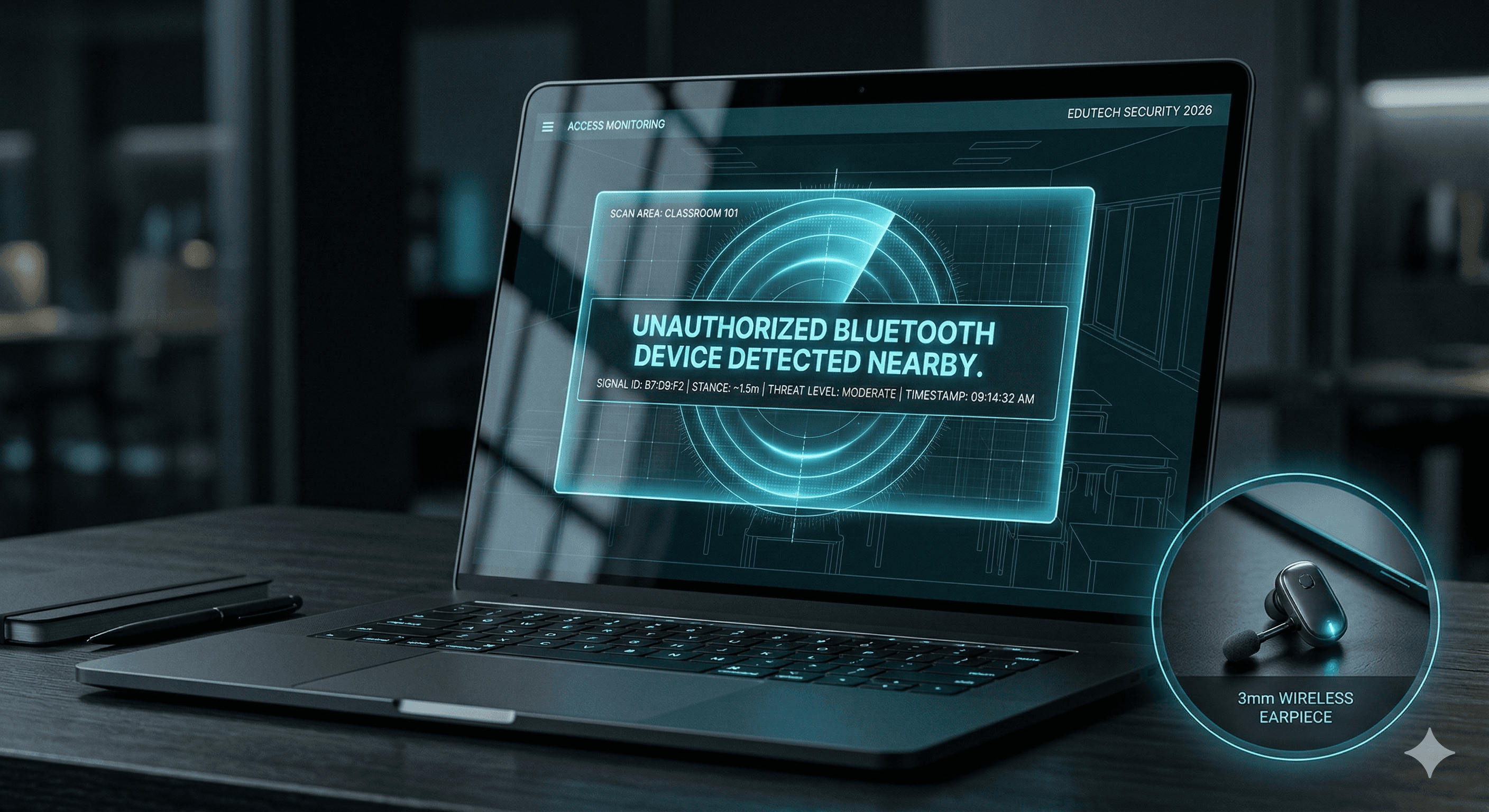
In 2026, the landscape of academic integrity has reached a critical tipping point. As generative AI becomes embedded in every operating system, the methods used to circumvent exam security have evolved from simple software tricks to sophisticated hardware interventions. While legacy proctoring systems continue to focus on browser lockdowns and webcam monitoring, a new "blind spot" has emerged: the use of micro-wireless devices that operate entirely outside the computer's internal environment.
To address this challenge, TrustExam.ai—built on a foundation of over 4 million exams and 6+ years of expertise—has introduced the Bluetooth Scanner. This technology provides a proactive environmental monitoring layer designed to detect active wireless signals in the test-taker’s immediate vicinity, ensuring a fair and credible testing environment for all.
The Hardware Cheating Epidemic of 2026
Traditional proctoring methods were designed for an era where cheating meant opening a hidden tab or looking at a physical cheat sheet. Today, students have access to an entire marketplace of "invisible" hardware:
Micro-Earpieces: Devices as small as 3mm (smaller than a bean) that sit deep within the ear canal, undetectable by standard webcams.
AI-Powered Smartwatches: Wearables that can receive real-time text prompts or voice-to-text answers without the student ever touching their keyboard.
Hidden External Communicators: Smartphones or tablets hidden in backpacks or under desks that pair with earbuds to provide a live audio feed of answers.
Because these devices do not connect to the exam PC, they do not appear in task managers or browser logs. Legacy proctoring systems that only monitor the computer's "software state" are essentially blind to this hardware-based fraud.
How the Bluetooth Scanner Works: A Technical Deep-Dive
TrustExam.ai’s Bluetooth Scanner acts as a radio-frequency (RF) sentinel. It does not monitor the student's screen; it monitors the radio-frequency environment surrounding the student.
1. Spectrum Observation
During the exam session, the TrustExam.ai application periodically activates a passive observation mode of the local Bluetooth spectrum. It identifies all active signals within range without requiring a physical connection to those devices.
2. Signal Strength Analysis (RSSI)
The system's intelligence lies in its use of Received Signal Strength Indicator (RSSI) metrics. Simply detecting a signal is not enough—in a modern home or university dorm, there may be dozens of Bluetooth devices in neighboring rooms. TrustExam.ai analyzes the decibel level of the signal:
Weak Signals: Categorized as background noise (devices in other rooms or on other floors).
Strong Signals: If the RSSI exceeds a specific threshold, the system identifies the device as being within "arm's reach" of the student.
3. Real-Time Intervention
If an active, high-strength signal is detected, the system immediately pauses the exam. The interface displays a clear warning: "Bluetooth device detected nearby. Disconnect it to continue the exam". The student must then disable the device or remove it from the workspace before the proctoring agent allows the session to resume.
Bluetooth Scanner vs. Legacy "Lockdown" Methods
Feature | Legacy Lockdown Browsers | TrustExam.ai Bluetooth Scanner |
Detection Method | Monitors internal PC processes | Monitors external RF environment |
Micro-Earbud Detection | None (unless connected to PC) | 97% Detection Probability |
Smartwatch Blocking | Can block PC notifications only | Detects the active pairing signal |
External Phone Use | Fails to detect nearby devices | Identifies signals within arm's reach |
By combining this RF monitoring with our AI Behavioral Proctoring—which tracks over 40 categories of suspicious behavior in real-time—TrustExam.ai closes the gap that hardware manufacturers have exploited for years.
Case Study: Ensuring Integrity at National Scale
The efficacy of TrustExam.ai’s hardware detection is not theoretical. In our implementation for the National Driving License program, we have conducted over 1.3 million tests since October 2023.
In high-stakes certification environments where "impersonation networks" often provide candidates with hidden earpieces, TrustExam.ai achieved a 100% prevention rate of impersonation attempts and blocked unauthorized remote access entirely. This level of security helped the government uncover corruption schemes valued at over $500,000 USD.
Privacy and Compliance: GDPR and FERPA Standards
As we move through 2026, privacy expectations are stricter than ever. Many institutions are wary of technologies that "scan" environments. It is critical to define what the TrustExam.ai Bluetooth Scanner does not do:
No Data Access: The scanner never connects to the student’s phone or watch. It has no access to personal files, photos, or messages.
No Remote Control: The system cannot turn off the student's devices; it simply alerts the student that they must be turned off manually.
Zero-Knowledge Encryption: All session logs and metadata are protected with enterprise-grade encryption and stored in region-specific data centers to comply with local laws.
Our philosophy is "Privacy by Design." We ensure that integrity does not come at the cost of the student’s dignity or data security.
Frequently Asked Questions (FAQ)
How does proctoring detect Bluetooth earpieces?
In 2026, advanced systems like TrustExam.ai use Bluetooth Scanners that monitor the radio-frequency environment. By analyzing the Signal Strength (RSSI), the system can identify active earpieces within the student's immediate workspace, even if they are smaller than 3mm.
Can a student use a smartwatch during an online exam?
Most academic integrity codes strictly prohibit smartwatches. TrustExam.ai detects the active Bluetooth pairing between the watch and a nearby phone, triggering an immediate warning that requires the device to be disconnected before the exam can proceed.
Does the Bluetooth Scanner read my personal messages?
No. The TrustExam.ai scanner is a passive listener of signals; it does not "pair" with or "handshake" with your devices. It cannot access, read, or store any personal content from your mobile phone or wearables.
What happens if the system detects a Bluetooth signal from a neighbor?
TrustExam.ai utilizes signal strength filtering. If a neighbor’s Bluetooth signal is detected, the low RSSI value allows the AI to categorize it as "out-of-range noise," preventing false positives and unnecessary interruptions.
Nurali Sarbakysh
CEO
Share