Блог
Кейс
Казахстанские водительские права Экзамен Целостность
Как TrustExam.ai приблизился к целостности знаний-тестов водительских прав в Казахстане, используя проверки личности на уровне сидений, безопасные рабочие станции, обнаружение устройств и виртуальных машин, аудиторские маршруты и рабочие процессы призывов.
Нурали Сарбакиш
Генеральный директор

I am Nurali, CEO at TrustExam.ai. Over the last six years I have worked with education and government teams on exam integrity in regulated, high-volume programs. Driver license knowledge testing in Kazakhstan taught a clear lesson: integrity is not a single control. It is a system of evidence, operations, and governance that must survive audits and public scrutiny. This case study shares the threat model we used, the detection layers that mattered, and a rollout playbook you can adapt.
Results at scale
Более 1,5 млн экзаменационных сессий
Supported through Kazakhstan’s driver-license knowledge testing program from October 2023 to the present.
80% reduction in recorded cheating incidents
Reported reduction compared with the program’s pre-TrustExam baseline before service began in October 2023.
Source: TrustExam.ai program statistics, October 2023–present.
Why theory-test integrity matters
A driver license knowledge test is a public safety gate. It is also a social trust contract. If candidates believe results can be bought, compliance drops. Honest candidates disengage. Audit bodies react. The testing operator becomes a political target. The challenge is scale: theory tests run across many centers with staff rotation and uneven infrastructure.
In Kazakhstan, the goal was not perfect prevention. The goal was fewer easy bypass paths, stronger evidence, and consistent decisions during reviews and appeals.
Threat model for driver license knowledge tests
Most fraud schemes fit three patterns. Impersonation and substitution: a proxy candidate sits the test for someone else. Covert assistance: a candidate receives answers via micro-earpiece, hidden camera, or a helper outside the room. Workstation bypass: remote access tools, virtualization, screen mirroring, or unauthorized peripherals expose external help.
Integrity controls used as a layered system
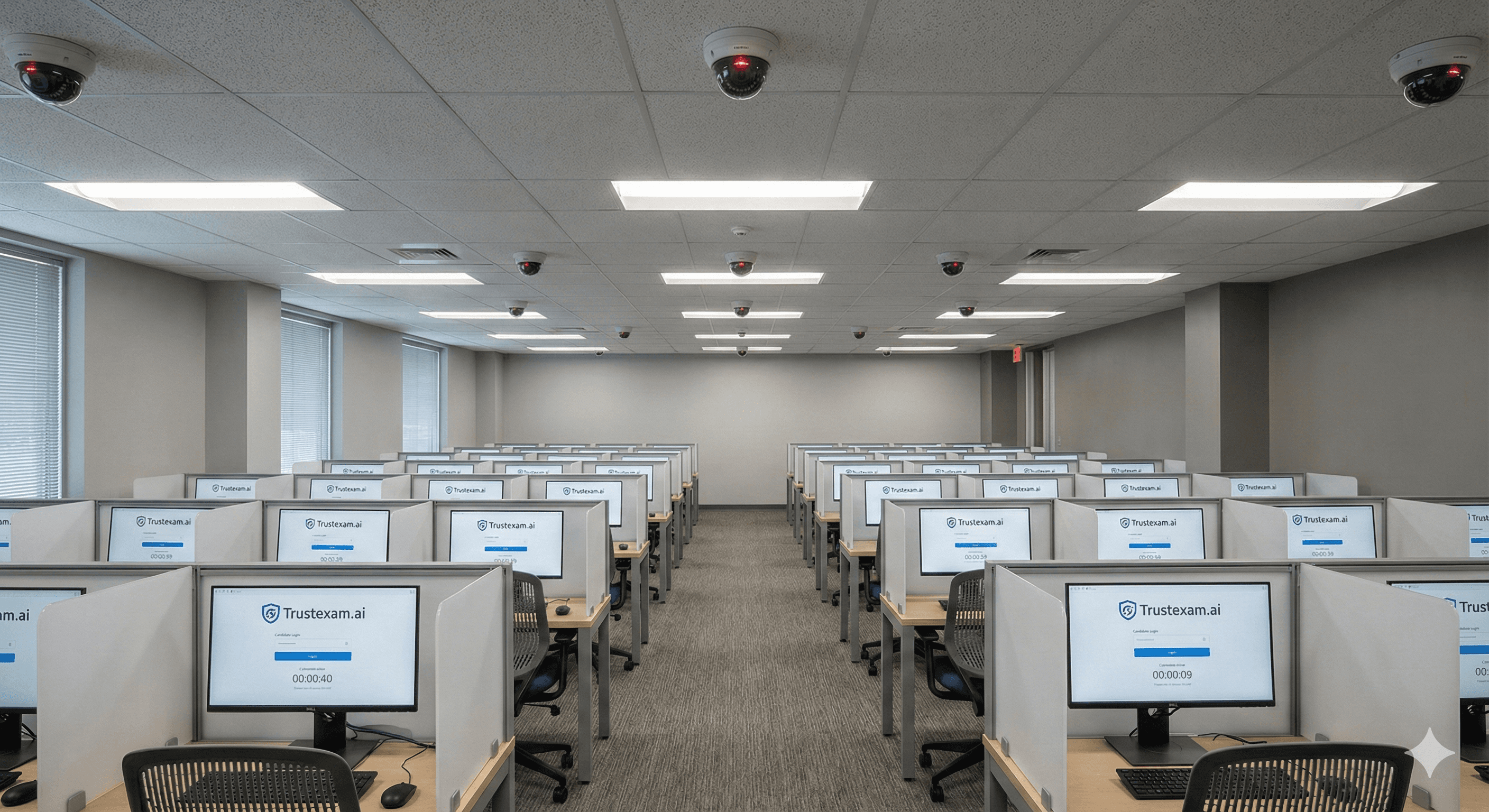
Results improved when we treated integrity as a stack. Each layer blocks a different bypass path. The stack also correlates signals into an evidence packet that reviewers and auditors understand.
Layer 1: seat-level identity assurance
Identity checks at the entrance are necessary, but not sufficient. The control point is the exam seat. We combined document checks with biometric verification and continuity checks during the session. This reduces substitution attempts and creates a baseline for investigation.
Operational principle
Treat identity as a continuous process, not a one-time gate. If outcomes must be defensible, build continuity at the seat and log it.
If your agency is exploring identity assurance for licensing exams, start with an integrity risk assessment and a pilot plan. TrustExam.ai supports identity checks, reviewer workflows, and audit-friendly evidence timelines. See how the platform works.
Layer 2: secure workstation and device integrity controls
In licensing tests, many attacks look like normal computer use. A secure browser alone is not enough. Controls should harden the workstation profile and monitor for known bypass classes: virtual machines, remote desktop tools, virtual camera feeds, unauthorized peripherals, and screen mirroring paths such as HDMI splitters. Standardization matters too. A common workstation profile reduces variance across centers and supports fairness.
Layer 3: detection of covert assistance and collusion
Covert assistance needs triage, not automatic punishment. Audio anomalies, behavior shifts, and timing patterns are useful when they trigger targeted review. Correlation is key. One signal can be noise. Multiple signals in the same time window warrant human review.
Layer 4: evidence packets for review and appeals
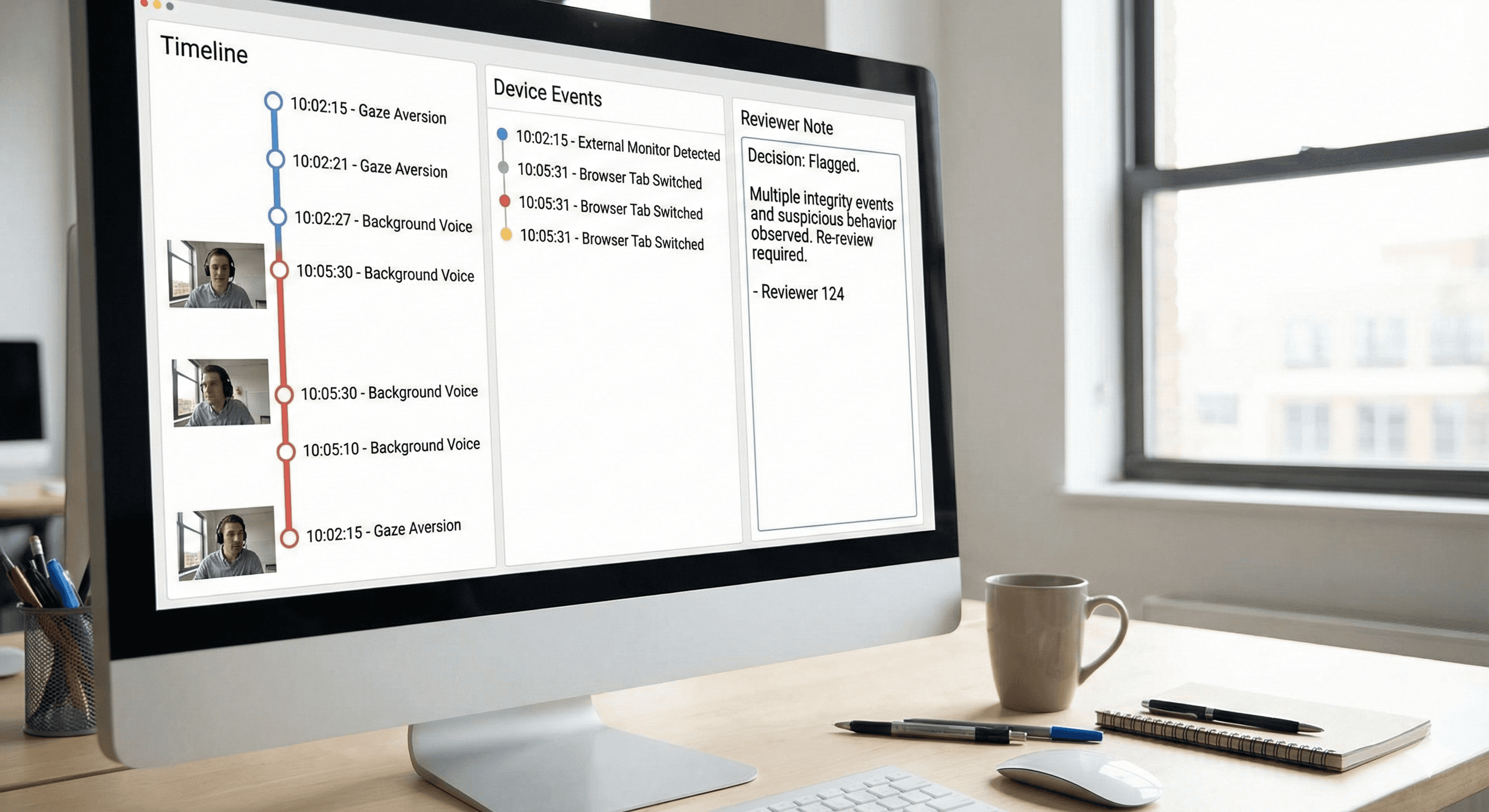
Detection without governance creates conflict. Reviewers need consistent evidence. Appeals teams need a repeatable format. We framed every flagged case as an evidence packet: a timeline of events, supporting signals, and reviewer notes. This reduces subjectivity and speeds up dispute handling.
Integrity controls compared
Method | Evidence strength | Cost | Scalability |
|---|---|---|---|
Room CCTV only | Medium | Medium | Medium |
Manual invigilators only | Medium | High | Low |
Seat-level identity checks only | Medium | Medium | High |
Secure workstation controls only | High | Medium | High |
Stack: identity + workstation + evidence timeline | High | Medium | High |
Implementation playbook: from pilot to national rollout
A driver license testing program is an operations project first. The biggest risk is inconsistent adoption across centers. We started with a pilot in a limited number of sites and defined measurable outcomes. We tested staff workflows, not only detection accuracy.
Before scaling, we standardized three assets: a workstation security baseline, a reviewer SOP, and a governance pack. The governance pack included the privacy notice, retention schedule, and role-based access policy.
Rollout checklist
Step | Owner | Deliverable |
|---|---|---|
Threat scenarios and thresholds | Exam authority + audit | Integrity rules document |
Privacy notice and retention policy | Legal + security | Governance pack |
Workstation lockdown baseline | IT + center ops | Standard workstation profile |
Identity verification workflow | Operations | Seat-level identity SOP |
Reviewer workflow and evidence format | QA + audit | Review SOP and templates |
Pilot and KPI baseline | Program lead | Pilot report and metrics |
Scale and quality audits | Operations + audit | Training plan and QA cadence |
Operational principle
Do not scale until reviewers explain decisions with the same wording in every region. Consistency is a control.
Governance: privacy, fairness, and human oversight
Integrity controls must respect privacy and due process. We recommend: data minimization, a retention schedule aligned to appeal windows, role-based access, immutable audit logs, and human-in-the-loop decisions for sanctions. Monitor regional variance and false positives.
For framing, NIST Digital Identity Guidelines help define assurance concepts. ISO/IEC 27001 helps structure security management expectations for vendors. ISO/IEC 30107-3 is useful when biometric liveness and presentation attack detection are in scope.
How to measure success
Track percent of sessions flagged for review, reviewer workload per 1,000 exams, appeals volume and resolution time, throughput per seat per day, and variance across centers. The objective is not perfection. The objective is fewer easy bypass paths and stronger evidence.
If you are benchmarking vendors, request a demonstration that shows the evidence packet and reviewer workflow—not just live monitoring. TrustExam.ai can share a licensing-exam pilot blueprint and procurement checklist based on large-scale deployments. Book a demo.
What this case demonstrates
The Kazakhstan driver license knowledge test case reinforced a pattern we see globally. Integrity succeeds when it is treated as a system: seat-level identity assurance, secure workstation controls, signal correlation, and an audit-ready review process. The fastest way to start is a scoped pilot with clear KPIs and a governance pack that procurement and auditors can approve.
Frequently asked questions
What is the first control to implement in a testing center?
Seat-level identity assurance, supported by logs, plus a standardized workstation lockdown baseline.
Can CCTV replace an integrity platform?
CCTV is useful context. It rarely provides evidence strong enough for consistent appeals handling.
How do we reduce candidate friction while improving integrity?
Use risk-based review. Apply strict checks only when signals correlate and thresholds are met.
What makes an exam integrity decision defensible in audits?
A consistent evidence packet, a reviewer SOP, role-based access, and a documented appeals process.
Нурали Сарбакиш
Генеральный директор
Поделиться